Sydney's median dwelling value sits at around $1.28 million in mid-2026, and the market has cooled slightly after a strong run through late 2025. That shift matters. Our residential property valuations are designed to help you determine the right property value in this changing market.
A bank's estimate, an agent's appraisal, and the true market value of a property can differ by tens of thousands of dollars. An accurate, independent valuation protects buyers, sellers, and investors; it stops you from overpaying, undervaluing, or negotiating from the wrong number. That's the value Sydney property valuers bring to every deal.

We have been able to emerge as one of the top and most trusted property valuers Sydney based on the principles we follow. We stand for:
Romeo Property Valuers is led by Vincent Romeo, a Certified Property Valuer (CPV) without limitation and an admitted NSW solicitor, a combination few valuation firms in Sydney can match. He spent eight years as a Board Member of the Australian Valuers Institute and sits on the Land Valuation Advisory Group, chaired by the NSW Valuer General, shaping valuation policy across the state. He’s also authored Property Valuations in NSW: The Definitive Guide, the reference many registered property valuers in NSW turn to. That’s the depth behind every professional property valuer on our team.

A property valuation is an independent, evidence-based assessment of what a property is genuinely worth on the open market, prepared by a qualified valuer, not an agent or algorithm. It considers factors like location, size, condition, recent sales data, and market trends.
Most property valuations in Sydney happen at a specific trigger point. Buying or selling a home is the obvious one.
Refinancing often calls for a fresh valuation, and so does calculating capital gains tax or stamp duty.
Deceased estates need one before assets are distributed, and family law settlements rely on one to divide property fairly.
If a bank's valuation feels low, a second professional valuation can shift a dispute.
Whatever the reason for the valuation, it's important to engage a Certified Property Valuer (CPV) with the qualifications and experience to provide an accurate, independent assessment.

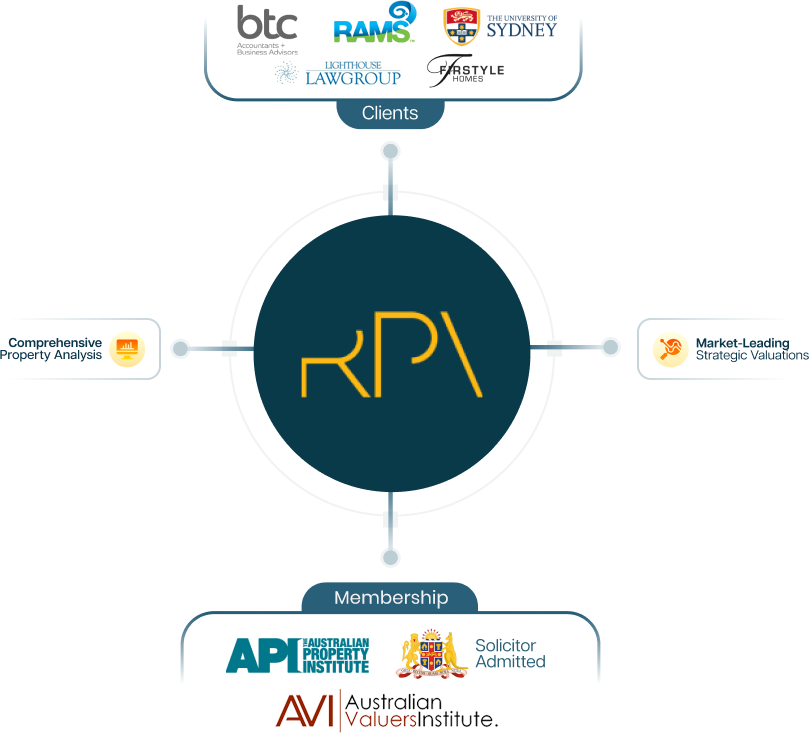
Our valuations are used by the ATO, Revenue NSW, and the NSW courts, and trusted by lawyers, conveyancers, accountants, tax agents, tax auditors, builders, surveyors, architects, developers, migration agents, real estate professionals, strata managers, owners corporations, investors, vendors, buyers, and many others across the property industry.

Our valuers hold CPV accreditation without limitation and API membership, the industry's highest professional standard. That means our reports are accepted by every major bank, by Revenue NSW, and by the NSW courts, so you're never left guessing whether yours will hold up.

We work across Sydney's inner-ring suburbs, the growing Western Sydney Airport corridor, St George, and out to the Hunter Valley. Each pocket moves differently; zoning, infrastructure spending, and buyer demand all play out at their own pace, and that local nuance shapes every valuation.

Time matters when you're mid-negotiation or racing a settlement date. Most residential reports go out within 24 to 48 hours of inspection, sometimes sooner. That speed comes from an efficient process, not a rushed one.

We currently sit at a 5.0 rating across 281 Google reviews, which says more than marketing copy ever could. Clients come to us for DHA rent reviews, contested court matters, and bank valuation disputes, and we treat each one with the same care.
Whether you're buying, selling, or refinancing, our residential property valuations give you a clear, defensible number. We look at location, condition, recent comparable sales, and current market trends to land on a figure you can actually rely on.
Apartment values swing more than people expect; building condition, strata health, and floor level all move the number. We assess each factor individually rather than applying a blanket suburb average, which is where many quick online estimates go wrong.
Owners corporations and strata managers often need a valuation that accounts for common property, shared facilities, and the strata scheme's overall condition, not just the individual lot. We factor in building health, sinking fund adequacy, and any special levies on the horizon.
Rural properties carry their own complexities: land use, water rights, and improvements like sheds or fencing all factor into the figure, alongside the same locational drivers that shape any Sydney valuation. We assess each holding on its own merits rather than applying a standard per-acre rate.
Acreage properties don't fit standard formulas; access, land quality, and possible uses vary enormously from one holding to the next. We factor it all in, so the valuation actually reflects the property rather than a generic per-hectare estimate.
Vacant blocks, subdividable land, and residential lots each depend heavily on zoning and development potential rather than on square metres alone. We dig into council overlays and demand signals to give you an honest picture of what the land is actually worth.

CBD office towers and suburban office parks are valued on completely different logic; occupancy, amenity, and lease structure mean something different in each setting. We work across both, which keeps our numbers grounded rather than generic.

A retail property valuation Sydney landlords and tenants trust needs to weigh foot traffic, lease terms, and tenant mix, not just the address. We've valued everything from strip shops to shopping centres, and we know how differently each of those actually performs.

Mixed-use buildings combine retail, office, or residential components under one title, and each element needs to be assessed on its own terms before being brought together into a single figure. We weigh the income and comparison approaches side by side to reflect the full asset.

Hotels, restaurants, cafes, pubs, and short-stay accommodation are valued on trading performance as much as bricks and mortar. We factor in turnover, licensing, and going-concern value alongside the underlying real estate.

Demand for industrial space is strongest right now in south-western and outer-western Sydney, and that's where a lot of our recent instructions have come from. Warehouses, distribution centres, and manufacturing sites each carry their own valuation quirks, and we know them well.
If you're a landlord resetting rent, a tenant facing a review, or an investor checking whether a lease is still competitive, a rental valuation gives you a defensible number to negotiate from, instead of relying on a guess or an outdated figure.
Before committing to a project, developers need to know the numbers actually stack up. We assess DA-approved sites using residual land value methodology, factoring in construction costs and market demand, so you're making that call with real figures, not hope.
Self-managed super funds need compliant, independent valuations of property assets, and accountants need defensible figures for financial reporting. We provide both assessments built for SMSF compliance and accounting purposes, not just a rough number to file away.
Boundary disputes, encroaching structures, and registered easements can all affect market value, sometimes significantly. We identify how these issues impact a property's saleability and provide a valuation that reflects the real-world constraints on the title.
Hospitals, medical centres, consulting suites, and healthcare facilities come with fit-out, compliance, and tenancy considerations that differ from standard commercial space. We account for these when assessing income potential and market value.
Service stations and petroleum sites carry environmental, licensing, and remediation considerations that directly affect value. We work through these alongside standard income and land-value analysis.
Schools, childcare centres, churches, and other community or specialty-use properties often have limited comparable sales, so valuation relies more heavily on replacement cost and specific-use analysis.
Car parks, aged care facilities, and other purpose-built assets each come with their own valuation logic. We draw on the right approach for the asset rather than forcing a one-size-fits-all method.
Romeo Property Valuers’ provide comprehensive, market-leading valuation and property advice that will enable you to make informed financial decisions.
Once the initial consultation is complete, we thoroughly inspect the subject property, assessing its condition, features, and unique characteristics. This on-site inspection provides valuable insights that inform our valuation analysis.
We comprehensively analyse the local property market, considering factors such as recent sales data, market trends, economic indicators, and demand-supply dynamics. This market analysis helps us determine the fair market value of the subject property accurately.
Based on our property inspection and market analysis, we prepare a detailed valuation report outlining our assessment of the property's value. The report includes supporting data, analysis, and explanations to provide clients with a clear understanding of our valuation methodology and conclusions.
Our team is headed by Vincent Romeo, a certified property valuer and an admitted solicitor specialising in property valuation law in NSW. He leads a team of accredited valuers who are dedicated to providing you with accurate and reliable property valuations. We strive to deliver market-leading insights and strategic property advice, enabling our clients to make smart and informed financial decisions.
For reliable property valuation in Sydney, get in touch.

Most residential valuations are completed within 24 to 48 hours of the property inspection. Commercial and more complex matters can take a little longer, since they involve deeper research and analysis. Our Sydney property valuers move quickly without cutting corners, so you're never left waiting longer than necessary.
Yes, our valuers hold CPV (Certified Property Valuer) accreditation and are members of the Australian Property Institute (API). Our reports are accepted by all major banks and the NSW courts, so you can rely on them for finance, legal, or tax purposes. That's the standard you should expect from registered property valuers NSW owners can trust for these decisions.
A real estate agent's appraisal is an informal, often free estimate based on recent sales and market feel, while a property valuation is a formal, independent report prepared by a qualified valuer. Banks, courts, and government bodies generally won't accept an agent's appraisal for finance, tax, or legal purposes; they require a proper valuation.
Residential property valuations in Sydney typically start at around $250 plus GST, while commercial and industrial valuations start at around $550 plus GST. The final fee depends on the property type, its complexity, and the purpose of the report.
Romeo Property Valuers services the greater Sydney metropolitan area, including the Eastern Suburbs, North Shore, Inner West, Western Sydney, Hills District, St George, and Sutherland Shire. As Sydney valuers, we also take on instructions further afield across regional NSW when required.
Yes, in most cases, banks, courts, and the ATO require a valuation from a Certified Property Valuer rather than an agent's appraisal. This is especially true for finance applications, capital gains tax calculations, and any matter that could end up before a court; a CPV report carries the weight those situations demand.
Yes, we regularly prepare valuations for family law settlements, capital gains tax purposes, and deceased estates. These matters often need a report that can withstand scrutiny from the other party, the ATO, or the court, which is exactly the kind of work our property valuers in Sydney and NSW clients rely on us for.
To find a qualified property valuer near you in Sydney, choose a Certified Property Valuer (CPV) accredited by the Australian Property Institute (API) with experience in your local area and the valuation type you require.